

Director of Business Development, Brooks Automation
Pathology labs face growing pressure as more testing is needed each year across the broader healthcare system. Many labs cannot add staff or expand their space, so the workload keeps increasing. While modern analyzers run quickly, the manual work that surrounds them often sets the true pace of the lab.
These hands-on steps slow the workflow and pull staff away from higher value tasks that require their attention. As volumes rise, even small interruptions add up and create delays, increasing turn-around time.
Automation is helping labs change this pattern. Robots, adaptive grippers, and vision-guided tools take over the manual tasks that cause bottlenecks. This creates steadier specimen flow, more walk-away time, and a smoother path for staff to focus on higher-value work.
Manual Steps Prevent Pathology Labs From Meeting Diagnostic Demand
Pathology labs are under growing pressure as test volume increases. More people are getting screened, living longer, and being monitored for chronic conditions, which sends more specimens into the lab.
But most labs cannot hire new staff fast enough to keep up. Team sizes stay the same while both the number of tests and the complexity of each case continue to rise.
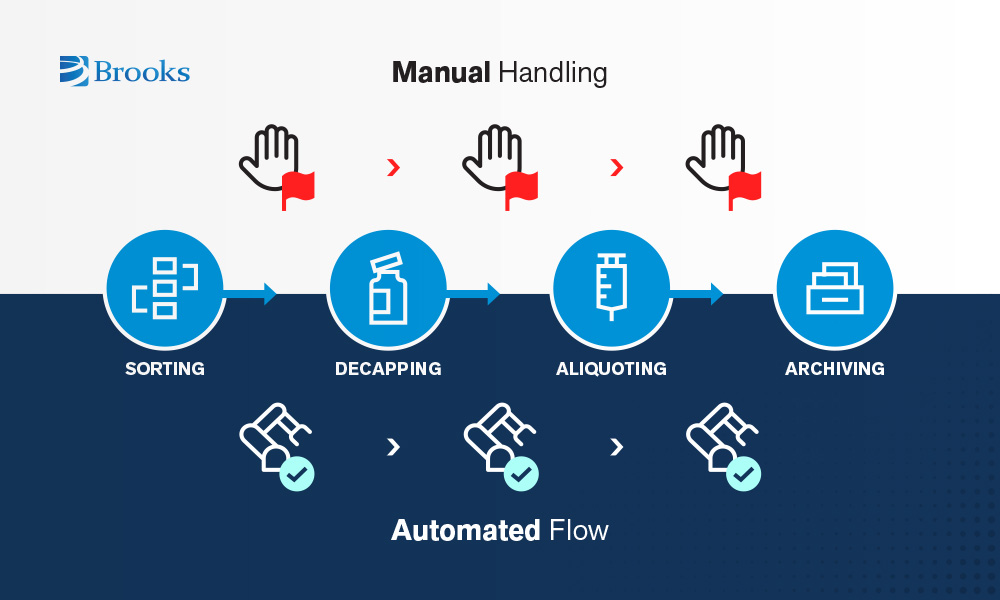
Automated flow allows labs to keep up with the demand without scaling their team size.
Manual Work Creates the Real Bottleneck
Modern analyzers can process samples quickly. The slowdown happens before and after testing, where most of the work is still done by hand.
In many labs, the early steps are almost fully manual. Staff receive the specimens and enter them into the system.
Then they perform tasks such as:
- sorting tubes by test type
- spinning samples in a centrifuge
- taking off caps
- splitting samples into new tubes when needed
- applying labels
- moving racks from one station to the next
Each step is prone to human error, especially through fatigue and repetition.
The analyzer can only run as fast as the samples it receives. Even a short delay in tube flow creates gaps in instrument use. If racks do not arrive on time, the analyzer sits idle even though it could process more.
Downstream steps add even more manual work. Staff often need to:
- seal (or cap) tubes
- store or archive specimens
- pull samples for add-on tests
- track down missing or misplaced material
These tasks build up during busy times and pull technologists away from higher-value work.
Small Errors Multiply Into Large Delays
Most delays in pathology come from simple handling mistakes. A tube with the wrong label can slow the entire process. When the lab is busy, a few minutes lost at each step can add up to hours by the end of the day.
Other industries, such as manufacturing, already follow a simple rule: steady flow leads to higher output. The same applies in a pathology lab. Analyzers can only run at full speed when correct samples reach them on time. That requires a workflow that is consistent and not slowed by manual steps.
A smooth, predictable flow from one stage to the next becomes the base for faster testing and better use of staff time.
Automating Specimen Handling From Sorting to Archiving
Automation helps remove early workflow slowdowns. It keeps the process steady, predictable, and less affected by staffing levels or daily workload changes.
Manual specimen handling creates a lot of variation in a pathology lab. Before a tube reaches an analyzer, it passes through several hands and several stations. Each handoff depends on timing, accuracy, and staff availability.
When these early steps rely on people, the workflow often slows during busy hours. Different shifts may also complete the same task in slightly different ways, which adds more variation. These small differences build up across the day and can delay testing.
Automation Stabilizes Every Step of the Workflow
Automation improves sample movement by making each step predictable and easy to track.
- Automated barcode checks confirm the tube’s identity at each handoff and update the lab’s computer system right away. This reduces scanning errors and keeps information consistent.
- Units that remove caps, split samples, and reseal tubes take away many manual touchpoints. This helps prevent spills, uneven volumes, and contamination on the bench.
- Smart storage systems place tubes in known locations and update their position automatically. This removes the guesswork when staff need to find a sample for an add-on test.
With these steps handled by machines, specimens move through the lab without the pauses that usually occur when staff become overloaded or pulled to other tasks.
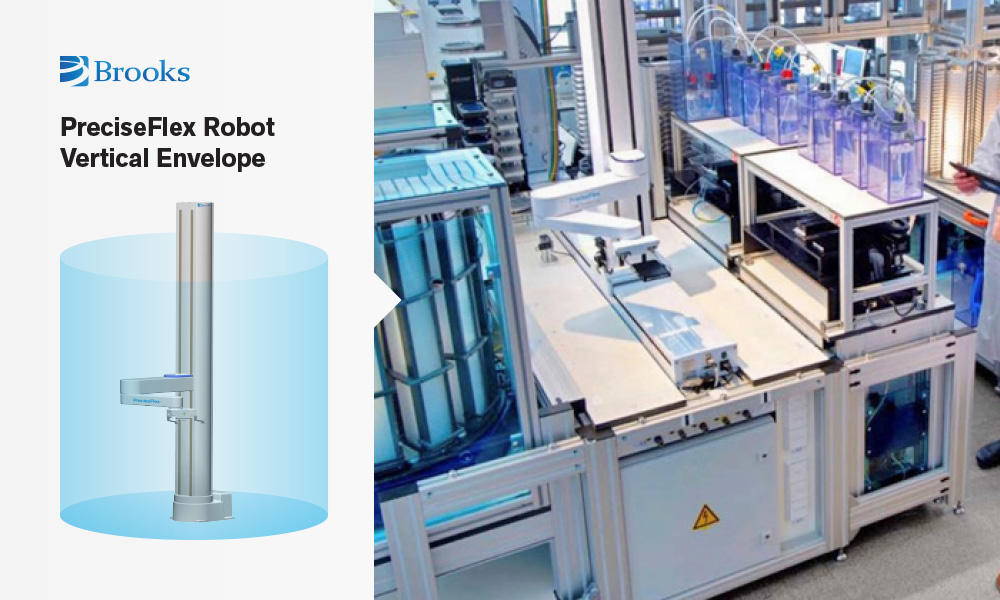
PreciseFlex™ robot integrated into a workflow using its compact size to automate surrounding lab processes and equipment.
Robots Close the Gaps Between Isolated Machines
Even with high-quality instruments, labs lose time when racks must be carried from one machine to another. PreciseFlex robots solve this in a unique way. Their vertical cylindrical work envelope lets labs place instruments much closer together, with the robot working in the small space between them. This removes the need for carts or long transfers and keeps everything compact.
Once the instruments are positioned this way, the robot helps keep the workflow running smoothly by:
- Moving racks between stations at a steady pace, which keeps analyzers supplied
- Reducing stop-and-start delays, especially when staff are busy or away
- Keeping work balanced across instruments, so one step does not fall behind
- Maintaining consistency, even during peak hours
Mobile robots become useful when instruments cannot be grouped closely, but the workspace-dense setup is the most efficient option for compact labs.
How PreciseFlex Robots Help
Brooks provides robot systems and intelligent handling tools that can be integrated into specimen workflows. PreciseFlex™ robots perform repetitive transfers in tight lab footprints, while IntelliGuide™ Vision and adaptive grippers support reliable picking and placement of mixed labware.
Together, these capabilities create more consistent throughput, fewer handling errors, less rework, and a predictable daily workflow. These improvements help labs optimize how their existing automation and staffing resources work together.
Automated Quality Control Prevents Delays and Diagnostic Errors
Quality issues in pathology often start long before a sample reaches a pathologist. Manual handling introduces small variations between samples, and these differences accumulate throughout the day. Common problems include:
- inconsistent fill levels,
- clotting or fibrin in sample
- wrong cap types,
- label issues, such as poor print quality or crooked placement, and
- improper storage.
In histology, manual work brings even more risk.
If tissue is not placed in the right position or the sections are cut at different thicknesses, the slide may be hard to read or may not meet digital imaging standards. These issues create delays, require extra cuts, and make the final results less reliable.
Automated QC Creates a More Predictable Workflow
Automation helps labs control quality at every stage of the process. It checks for problems early and keeps samples moving without delays.
- Before testing, automated systems can spot issues such as damaged labels, incorrect tubes, or low fill levels. Catching these problems right away prevents wasted time and keeps bad samples out of the workflow.
- During tissue processing, automated tools help create more consistent slides. They keep key steps the same each time, which leads to clearer and more reliable results.
- After testing, digital scanners add another layer of quality control by checking that images are sharp and complete. This helps prevent delays when results are reviewed.
By checking each step in real time, automated QC reduces uncertainty and keeps samples moving through the lab smoothly.
Robots and Vision Strengthen Quality Control
Robots add another layer of QC by verifying that every load matches the expected recipe before feeding an analyzer. IntelliGuide™ Vision supports this with auto-teach functions and embedded cameras that confirm tube identity, rack alignment, and orientation. When exceptions occur, image capture provides a clear record for traceability and investigation.
These tools help labs catch errors early and reduce problems that lead to redraws or repeat testing. They also cut down on differences between staff and shifts, which helps the lab produce consistent results throughout the day.
Robots Turn Repetitive Bench Work Into Walk-Away Time
Labs lose significant time to the repetitive movements that must occur between instruments. Technologists unload racks, re-rack tubes, load analyzers, and wait for cycles to finish. These tasks add no diagnostic value but determine how fast specimens move through the line.
When volume increases, these small delays pile up and slow the entire workflow. However, when you successfully automate these tasks with a robot, you get genuine walk-away time.
Repetitive Bench Work Creates Daily Bottlenecks
In many labs, the transfer steps between instruments are still done by hand.
Over time, this manual bottleneck becomes costly. It limits the full benefit of the lab’s existing automation and reduces the return on investment. When staff must focus on repetitive transfer work, the lab cannot reach the throughput its instruments are designed to deliver.
The operator removes racks from one machine, moves the tubes into a new holder, and loads them into the next analyzer. This cycle repeats all day.
Even when analyzers run quickly, this manual transfer becomes the step that slows everything down.
- This creates a bottleneck because:
- These tasks need constant attention.
- Skilled staff spend more time moving racks than solving problems or managing exceptions.
- The workflow becomes unpredictable during busy hours.
- It is harder to maintain a steady pace across the shift.
Together, these pressures make manual transfers one of the main barriers to faster and more consistent testing.
How PreciseFlex Removes the Middleman
A recent Brooks case study showed how a PreciseFlex™ 3400 robot helped improve walk-away time at Precision Diagnostics. The lab had a vial re-racking task that needed constant operator attention. The robot took over this full sequence.
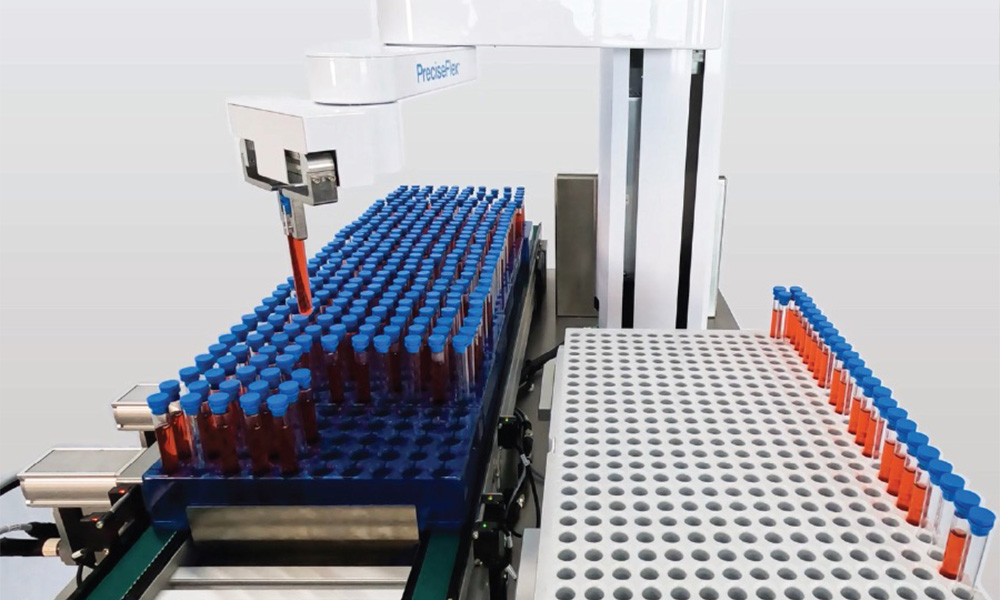
PreciseFlex™ 3400 robot in action.
The robot handled the workflow by:
- moving racks from one instrument to the next,
- re-racking vials into the correct holder format, and
- placing finished racks for the next processing step.
This change created about 30 minutes of walk-away time per cycle. Technologists no longer had to wait for each transfer. They could watch several processes at once, manage exceptions, and support other areas of the lab.
As the system ran through the day, benefits increased. Staff spent more time on higher-value work, and the movement of samples became steadier and easier to manage.
How To Choose the Right Application and Automation Partner
Choosing the right first application is the most important step in automation.
Labs should look for a task that is repetitive, slows down the workflow, and requires steady timing. These are the areas where robots create the most value.
By focusing on a single process that clearly needs support, teams can simplify the first deployment and build confidence before expanding to larger projects.
What to Look For in a Robot
Automated systems that support collaborative applications (cobots) must meet several key requirements:
- Fit into tight spaces and reach into existing instruments
- Operate safely near staff without needing large safety guards
- Work smoothly with barcode scanning and vision tools
- Use embedded controllers to avoid external cabinets and keep the footprint small
- Run reliably across long or multi-shift schedules
Vision and sensing also play a major role in flexibility. Intelligent vision systems, such as Brooks IntelliGuide™ Vision, support auto-teach functions and allow the robot to pick items in different orientations on trays and fixtures. This reduces the time spent updating programs when layouts or containers change.
Why Space and Flexibility Matter
Most labs do not have extra space to grow. Automation has to fit into crowded benches, tight aisles, and the gaps between existing instruments. Robots with cylindrical work envelopes make good use of limited space because they can reach more positions without needing a large clearance area.
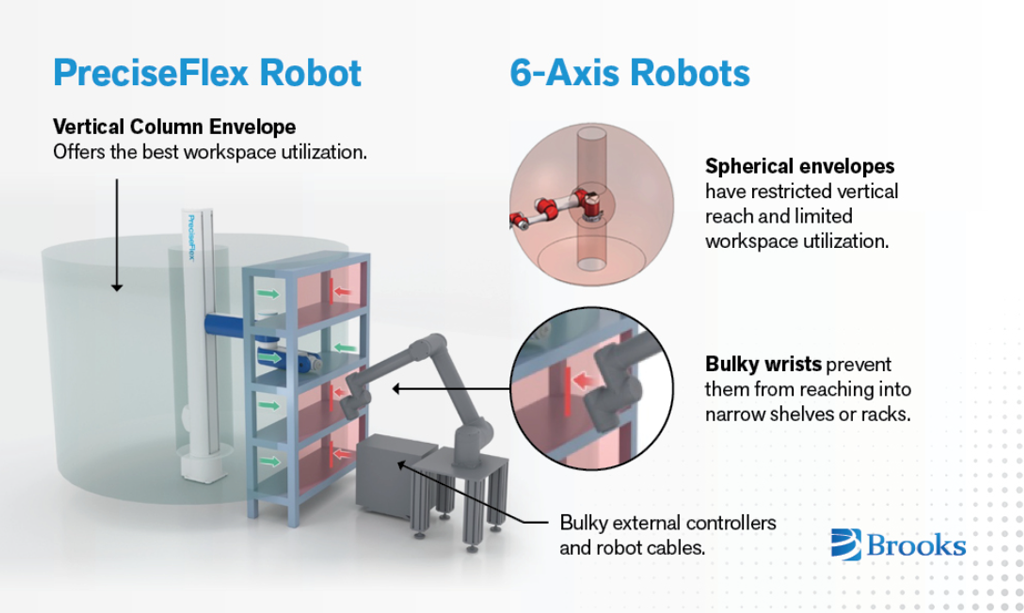
PreciseFlex™ vertical envelope ensures high robot accessibility with a compact work area.
Mobile robot platforms add even more flexibility. Labs can move automation between departments or shift capacity during peak hours without major changes to the layout.
Flexible robot cells also make it easier to grow in the future. Labs can add digital pathology tools, AI screening stations, or new test panels without rebuilding the entire workspace.
Comparing General Purpose and Lab Focused Robots
General-purpose six-axis robots can handle many tasks, but they usually need more space, more guarding, and more custom integration to work safely and accurately in a lab. Robots designed for labs are built for tighter areas, so they set up faster and fit easily into crowded benches.
For example, a PreciseFlex™ robot can sit between two analyzers on a narrow bench, reach all required positions, and handle different labware with help from vision tools. A general-purpose robot would need more room, extra safety hardware, and custom engineering to do the same job.
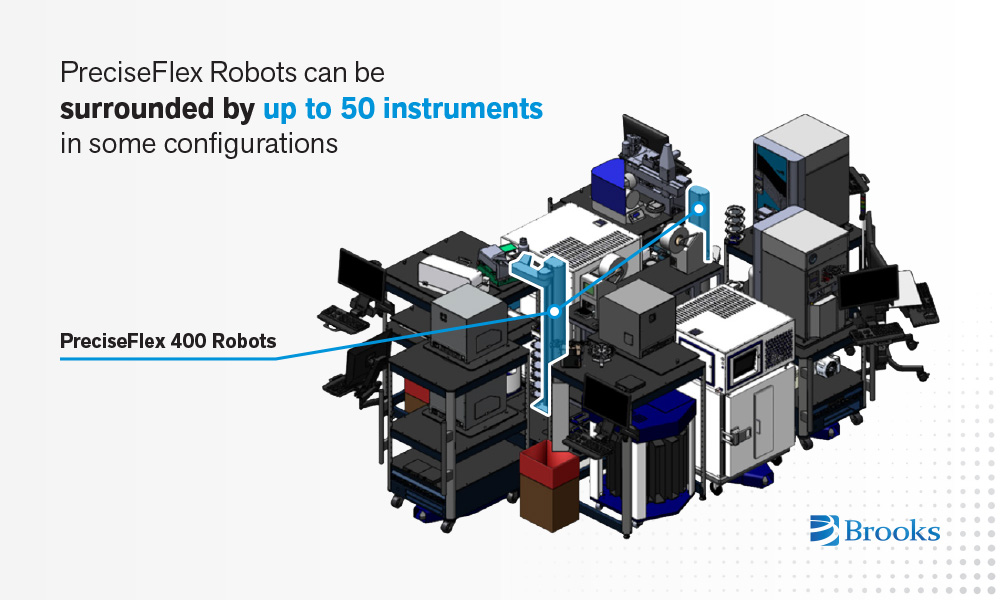
Image courtesy of HighRes
PreciseFlex™ robots can operate in extremely process-dense environments.
PreciseFlex™ robots are also significantly more power-efficient compared to traditional robotics. (Up to 67% less power use). This power efficiency doesn’t just save on energy, but keeps temperature-controlled labs easier to cool. Traditional robots lose power through generated heat, requiring more effort from AC to maintain the required temperatures.
Many traditional robots use harmonic drives, which waste about 20% of power, require more frequent maintenance, and have a typical life of 20,000 hours. In contrast, PreciseFlex™ robotics have a design life of up to 100,000 hours.
Why the Right Partner Matters
Pathology experience matters more than individual robot specs. The right partner understands how samples move through the lab, how they are tracked, and where delays occur. They design collaborative applications that create real walk-away time, not just a robot sitting in front of an instrument.
Brooks Automation follows this approach by offering solutions built for space-constrained, high-throughput labs that need reliable, easy-to-deploy automation.
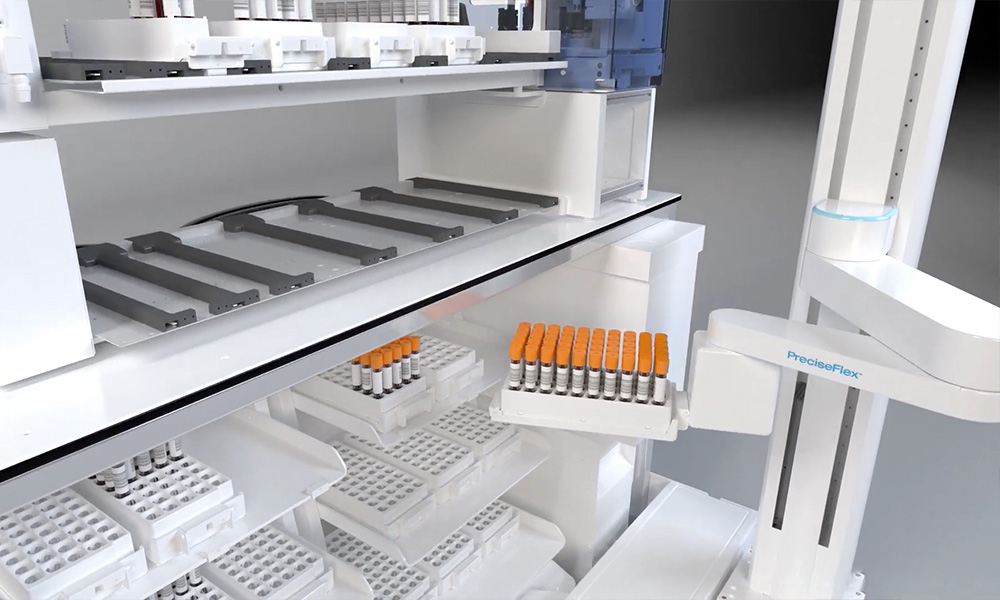
PreciseFlex™ robot stacking sample vials in a compact vertical shelving system.
Improving Throughput With Smarter Lab Automation
Pathology labs face growing demand, and manual specimen handling cannot keep up. The biggest improvements come from automating the steps before and after testing, because these areas cause most delays and variation.
When robots take over repetitive movements, the workflow becomes steadier and easier to scale. Staff gain more time for skilled tasks, instruments stay supplied, and daily throughput becomes more predictable. Labs that choose connected and flexible automation make the fastest progress toward faster, more reliable diagnostic work.
Brooks’ PreciseFlex™ robots bring these automation gains to real laboratory workflows, helping teams deploy faster, reduce manual handling, and keep specimens moving without interruption.