
Director of Business Development
Automation is changing how laboratories work. New systems are designed to make research faster, smarter, and more efficient. Recent data shows the Total Lab Automation (TLA) market was valued at USD 5.68 billion in 2024. It is projected to reach USD 11.3 billion by 2034, growing at a 7.15% CAGR.
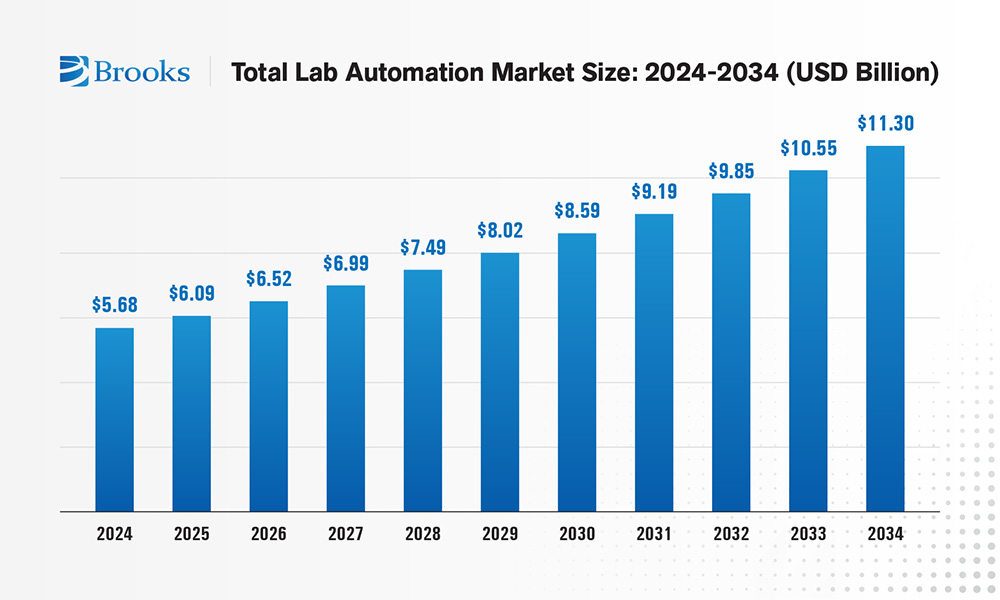
Total-Lab-Automation-Projection market size graph
Labs are moving away from rigid, single-purpose setups toward modular systems that are easier to deploy, maintain, and scale. Compact robots, mobile platforms, and AI-driven software now let teams manage more samples in less space and with fewer interruptions.
These technologies are replacing manual tasks and reshaping how labs plan space, share data, and collaborate. The following trends outline where lab automation is headed and what steps can help prepare for the next decade of change.
Modular and Compact Automation Will Redefine Lab Design
Labs that keep using large, fixed automation setups may struggle to keep up with those adopting modular, flexible systems. Compact and reconfigurable tools make it easier to add or move automation without redesigning the workspace or taking up extra bench space. These advancements give labs more freedom to adjust layouts as workflow requirements evolve.
To stay flexible:
- Choose mobile or rail-mounted robots with a minimal footprint.
- Use modular stations that can be reconfigured as workflows or instruments change.
- Free up expensive bench and floor space by stacking instruments and placing automation under or between existing instruments.
Practical guidelines:
- Select robots with built-in controls to avoid bulky external cabinets and save space.
- Ensure mechanical, electrical, and software interfaces support plug-and-play modules for fast setup.
- Map out real estate costs since reducing the footprint lowers facility expenses and increases usable lab area.
- Aim for automation setups that create walk-away time. In this setup, one system handles connected steps so staff do not need to tend each stage manually.
Labs that invest in flexible, compact systems today will avoid being limited by older, rigid automation that wastes valuable space and slows progress.
Case Study: Precision Diagnostics Gains 30 Minutes of Walkaway Time
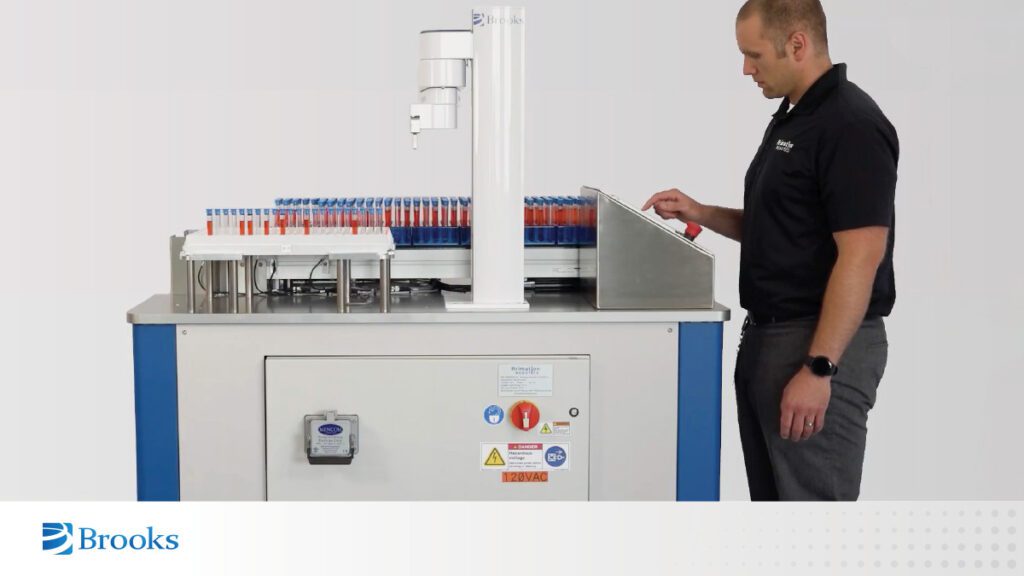
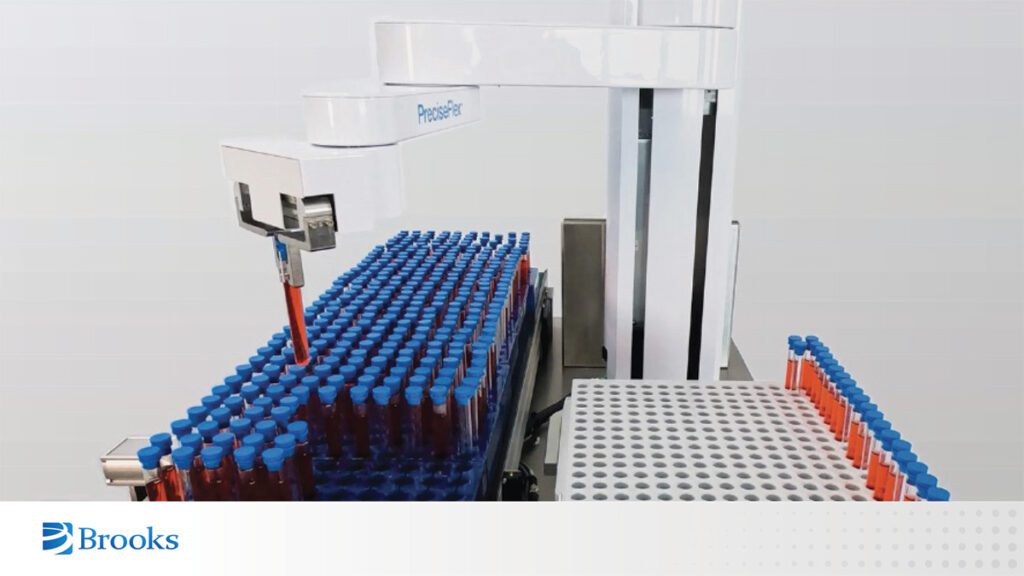
A recent case study between Brooks Automation and Arimation Robotics shows how compact automation can improve lab efficiency. Working with Precision Diagnostics, the teams used the PreciseFlex™ 3400 collaborative robot to automate a vial re-racking process between instruments.
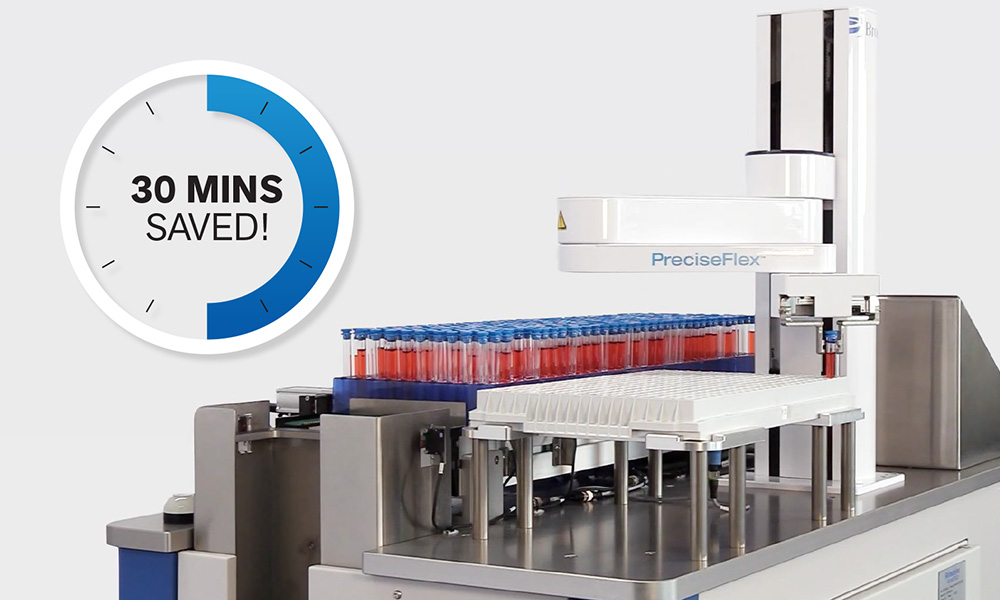
The new setup combined several manual steps into one automated cell. This allowed operators to focus on higher-value tasks and created 30 minutes of walk-away time per cycle. By removing the need for guarding and using a space-saving arm design, the system fits easily into a tight lab area while still reaching all required positions.
This project demonstrates how compact, flexible automation can boost productivity and reduce labor strain, while allowing the operator to focus on less strenuous tasks. All while making better use of valuable lab space.
Uptime and Throughput Will Drive Competitive Advantage
Throughput alone is no longer enough to stay competitive. Leading labs lose the least time to recovery, reprogramming, or maintenance. Every minute a system sits idle represents wasted capacity and lost productivity. For screening environments, maintaining high-throughput performance while minimizing interruptions is essential. But sustained uptime often determines how effectively a lab turns raw speed into real discoveries.
To stay ahead, focus on automation that is built for rapid recovery and reliability:
- Systems with remote diagnostics and readily available parts shorten downtime.
- Tracking performance as usable cycles per shift, rather than peak speed, gives a more accurate picture of real productivity.
- Prioritize process stability and steady throughput to keep high-volume operations running all day efficiently.
Practical steps:
- Request MTBF and MTTR data to evaluate system reliability.
- Build redundancy or hot-swap capacity into critical steps.
- Quantify the cost of downtime per hour to justify investment in uptime-optimized equipment.
Labs that prioritize uptime and recovery speed will achieve more consistent results, faster returns, and a stronger competitive edge.
Maximizing Uptime with IntelliGuide™ Vision
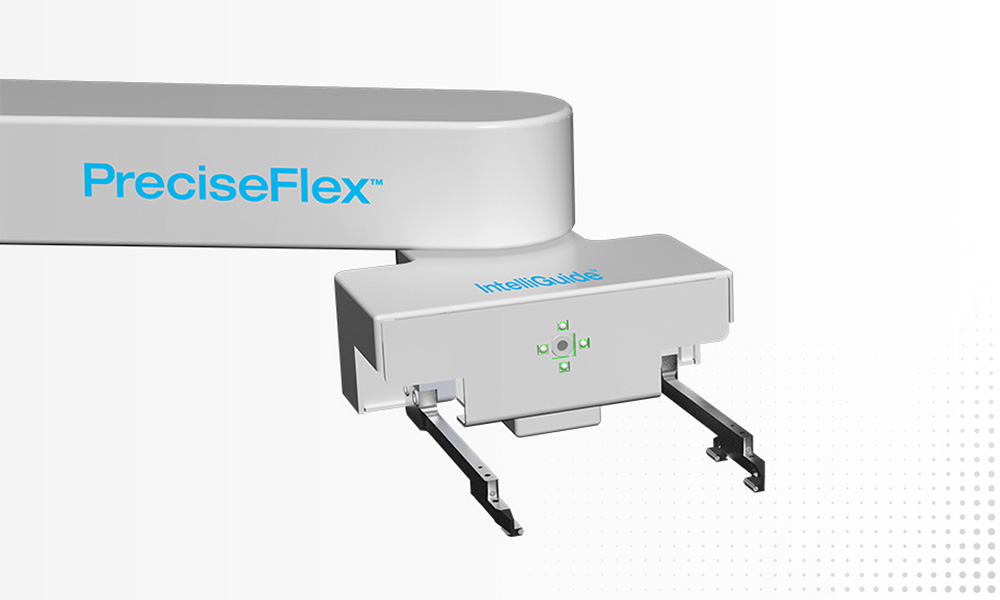
IntelliGuide™ Vision for PreciseFlex™ robots helps minimize downtime through built-in resilience. Its factory-calibrated, forward- and downward-facing cameras enable fast deployment and automatic workspace adaptation. When nests or hotels shift, the system uses Auto-Teach to correct positions automatically. This capability keeps the robot running without manual reteaching. The result is faster recovery and consistent throughput across long production runs.
AI and Data Integration Will Power Smarter, Self-Optimizing Labs
The next generation of lab automation will no longer stop at executing programmed tasks. Instead, artificial intelligence will help automated systems learn from every cycle, predict issues before they occur, and adjust operations in real time. By integrating data from laboratory information management systems (LIMS), electronic lab notebooks (ELN), and robot telemetry, labs can use AI to flag anomalies, schedule maintenance, and optimize experiment timing.

When data becomes decision support, automation moves from repetition to intelligence. AI can recommend which experiment to run next, predict when a robot will need service, or determine how to balance workload across multiple instruments. Over time, this creates self-optimizing workflows that continuously improve precision and throughput.
Implementation tactics:
- Choose automation platforms with open APIs and data-export capabilities that integrate easily with analytics and LIMS software.
- Prioritize modules that log event data, vision snapshots, and runtime metrics for real-time analysis and predictive modeling.
- Start small by applying AI to predictive maintenance, such as tracking motor temperature, gripper cycles, or tool wear. Then expand into workflow optimization once your systems prove stable.
By treating data as a strategic asset, labs can move from reacting to problems to preventing them. Automation paired with AI transforms every test, transfer, and cycle into actionable insight, creating smarter and more resilient operations.
Fast, Collaborative, and Seamless Automation Will Drive Adoption
Slow, custom integrations drain resources and delay results. Labs are shifting toward systems that arrive pre-integrated and can be validated and running within weeks, not months. Success depends on how easily humans can work with automation. This includes teaching, adjusting, and scaling without relying on specialized programming skills.
Adoption essentials:
- Choose robots with guided interfaces and auto-teach features to shorten commissioning and validation times.
- Ensure systems integrate with LIMS and lab software with minimal coding.
- Train staff to confidently operate and troubleshoot robots using visual tools, not code.
Labs that combine speed, collaboration, and seamless integration will reach full productivity faster and achieve a quicker return on investment.
Fast Deployment with PreciseFlex™
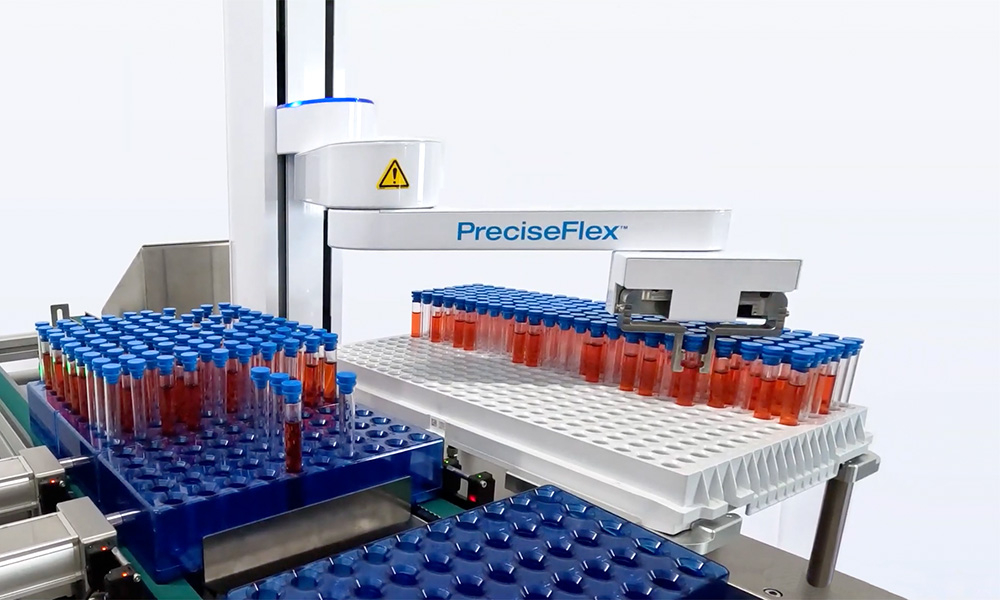
Brooks’ PreciseFlex™ robots show what fast deployment looks like in practice. With built-in controls that remove bulky cabinets, setup can be completed in hours rather than days. Combined with IntelliGuide™ Vision, the system can be taught visually through guided interfaces, allowing technicians to adjust layouts without programming.
The forward- and downward-facing cameras read 1D and 2D barcodes and capture time-stamped images for full traceability. They also automatically re-teach positions when the workspace changes, allowing operations to resume in minutes instead of hours.
When paired with adaptive grippers, a single robot can handle multiple container types or labware formats without mechanical changeovers. In real-world deployments, labs have completed installation and reached production testing within a week of delivery.
Scalable Automation Will Make Advanced Tools Accessible to Every Lab
High-end automation used to belong only to large pharmaceutical and genomics centers. Today, modular and compact technologies are lowering that barrier. Scalable systems let smaller labs automate one process at a time, expand as demand grows, and avoid the cost of full-scale systems from the start.
Why scalability matters:
- Modular automation kits let labs add capacity incrementally without disrupting existing workflows.
- Usage-based or leasing models make advanced robotics more attainable because they remove the need for large upfront investments. They also reduce the risk of putting capital into systems that may become outdated.
- Compact systems fit on standard benches and connect to shared infrastructure. This helps reduce both real estate and utility costs.
Labs that start small and scale intelligently can match the output and quality of much larger facilities. By investing in modular automation that grows over time, they build resilience, reduce labor dependency, and compete on innovation rather than size or capital strength.
Scaling with PreciseFlex™ and Open-source TCS API
Brooks’ PreciseFlex™ family includes models that scale from benchtop setups to mobile platforms, allowing labs to expand capacity as volumes rise. Optional linear rails in 1000, 1500, and 2000 mm lengths extend horizontal reach without adding more robots, maximizing coverage within the same footprint.
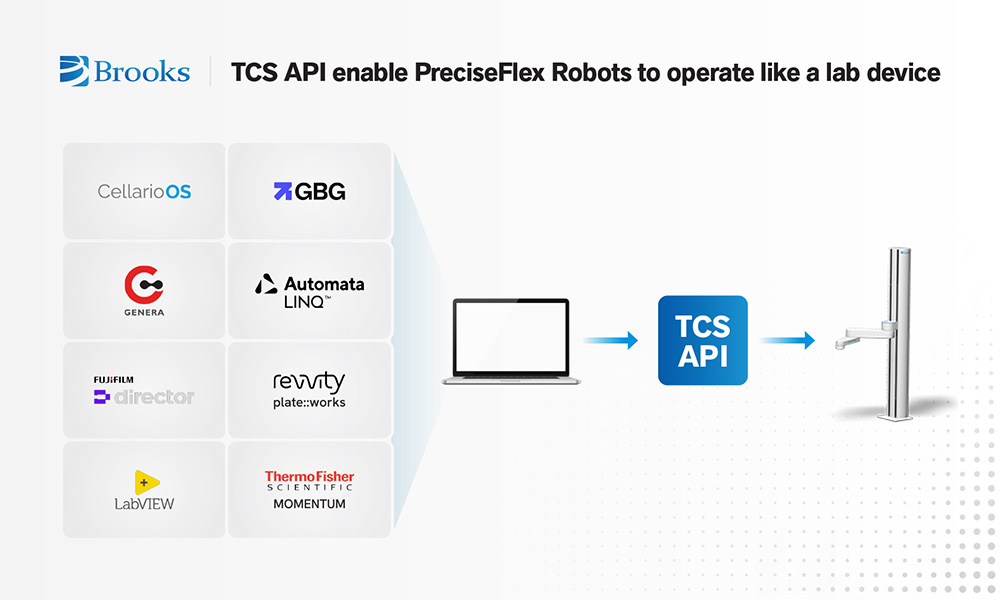
Brooks’ TCS API lets labs control PreciseFlex™ robots in real time from platforms like Cellario, LabVIEW, LINQ, Momentum, and more.
Paired with Brooks’ TCS API software, these systems integrate easily with scheduling or LIMS platforms, letting smaller labs grow automation capability in controlled, affordable steps. Once the TCS API is implemented into a workflow control software, any Brooks robot and linear rail configuration can be controlled with zero robot or application specific code required. TCS enables software developers to embed the robot into one common user interface and create an experience that best fits their application of the robot.
Preparing Today for the Lab of Tomorrow
The next decade of lab automation will reward adaptability. Systems that evolve as quickly as the science they support will define success. Modular robots, AI-driven workflows, and collaborative tools are already setting new standards for productivity, scalability, and uptime. Labs that invest early in flexible, compact, and easily integrated automation will stay ahead of rising costs, space constraints, and staffing challenges.