
Product Manager, Brooks Automation
Lab automation often breaks down between islands of automation, not inside them.
Even when instruments run automated processes, samples still need to move between benches, storage, analyzers, and departments. When that movement depends on staff, workflows slow down and expensive instruments can sit idle.
Mobile robots help close that gap by moving materials between process steps without changing how the lab functions.
Why Fixed Lab Automation Isn’t Enough Anymore
Fixed automation solutions play an important role in lab productivity. Automated instruments can run defined processes with speed and consistency. They work especially well when the workflow stays within one system or one controlled area.
The problem is that many labs are not one continuous automated system. They are a collection of automation islands.
A liquid handler, analyzer, storage system, or incubator may work well on its own. But samples, plates, reagents, and materials still need to move to the next system. When those handoffs depend on staff, the workflow is only partly automated.
That gap becomes harder to manage as labs handle higher sample volumes, generate more data, and struggle to find and retain skilled staff. It is especially difficult in R&D environments, where workflows can change often as teams adjust experiments, add instruments, or shift priorities. A fixed layout that works for one process may not adapt easily to the next.
Instrument access creates another constraint. Many high-value lab instruments can cost hundreds of thousands of dollars. If those instruments are tied to one department or one fixed automation island, other teams may wait for access or consider duplicating equipment.
Labs need a way to connect the assets they already have. They shouldn’t necessarily replace fixed systems. It’s more about closing the gaps between systems, departments, and instruments. This is how labs can move materials more consistently without rebuilding the entire workflow or overloading their staff.
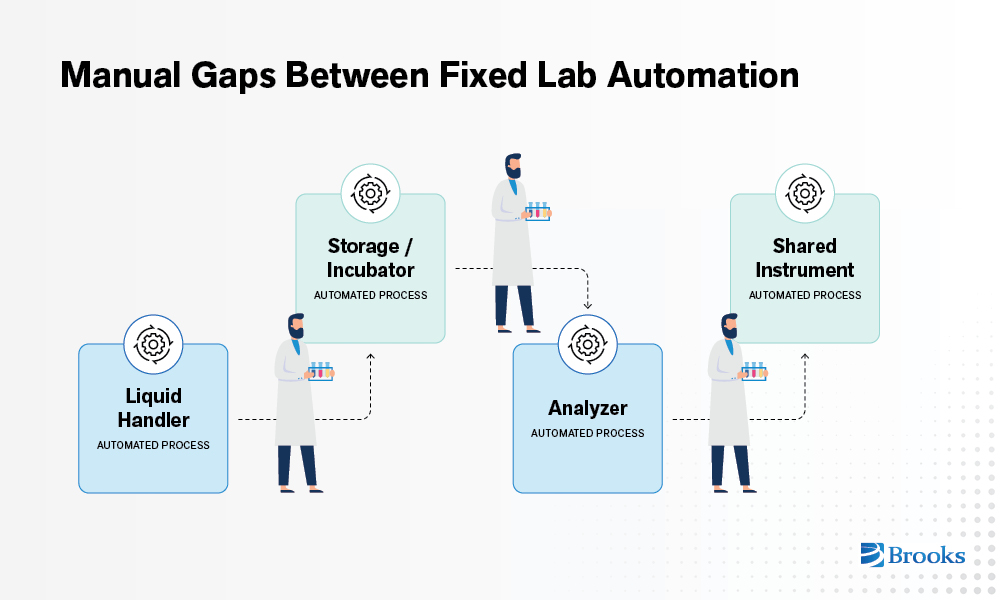
Closing the gaps between systems using mobile robots can improve utilization of existing lab equipment.
How Mobile Robots Improve Throughput and Instrument Access
Mobile robots improve lab throughput by managing the movement that happens between process steps. In many labs, this includes transporting:
- SBS plates and other Labware
- Samples and reagents
- Consumables and waste
- Materials between benches, storage areas, incubators, analyzers, and other lab zones
This movement can add up quickly when workflows span multiple rooms, floors, or departments.
Over weeks and months, a mobile robot can complete thousands of transport routes, potentially replacing hundreds of kilometers walking time and effort while keeping materials moving and bridging the processes.
The throughput benefit comes from reducing the waiting time between steps. Instead of a sample sitting until a staff member is available to move it, a mobile robot can transport it when the next process is ready. That helps keep workflows moving and reduces the time skilled staff spend walking materials across the lab.
Mobile robots can also support off-hours movement. Labware can be staged before a team arrives in the morning, or materials can move to the next process after normal working hours. This helps labs use more of the day without asking employees to cover repetitive transport tasks.
Instrument access is another major advantage. If multiple teams need the same high-cost analyzer or shared instrument, mobile robots can move samples to and from it. This helps keep the instrument available to more than one fixed workflow. This can help labs avoid duplicating expensive equipment while giving more teams access to the tools they already have.
As demand changes, mobile robots also give labs a scalable way to adjust. Teams can add robots, reassign routes, or connect more process steps. They do not need fixed conveyors or a full lab layout redesign.
Why Lab Mobility Is Hard to Execute
Lab mobility is hard because lab environments require a high degree of precision and reliability. Mobile robots may need to move through narrow aisles and around benches, carts, stools, doors, people, and sensitive instruments.
Those conditions can change throughout the day. A route that worked during mapping may later be affected by:
- A parked cart
- An open door
- Staff activity near a workstation
- Temporary materials placed in the robot’s path
- Even something simple as a misplaced chair
Final positioning creates another challenge. AMRs (autonomous mobile robots) can often navigate close to a target, but “close” is not always accurate enough for lab automation. If a robot needs to pick up a tray, place labware, or load an instrument, the system needs much tighter alignment than general navigation can provide.
Many AMRs localize in the centimeter range. Labware handling often needs millimeter-level accuracy at the final pick/place point. That is why mobile manipulation is more complex than transport alone. Transport gets samples to the right area. Manipulation requires reliable picking, placing, loading, and unloading.
This requires coordination between the AMR, robot, gripper, vision system, and workflow software. If one part of that system is out of sync, the workflow can stall or require manual correction.
Stability also matters. Adding a manipulator to an AMR changes the system’s center of gravity. If the arm reaches too far outside the AMR footprint, tipping risk can increase. Labs should review AMR documentation and perform proper center-of-gravity analysis before deployment.
How Mobile Robots Integrate With Lab Systems
Mobile robots need more than a destination. To support a lab workflow, the system needs to know:
- What should move
- Where it should go
- When should it move
- What to do if conditions change
That makes integration a software and command-layer problem. AMR software may handle mapping, routing, fleet management, and navigation. Robot control software may handle picking, placing, gripper force, vision guidance, and instrument interaction.
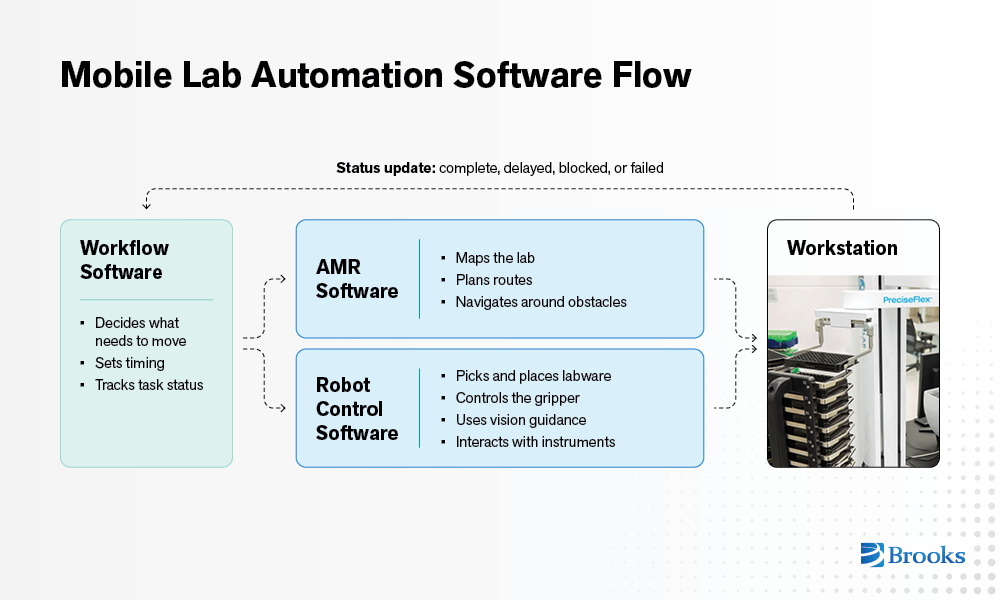
Mobile robots integrate with lab systems using software that provides critical information for robot activity.
PreciseFlex software supports this type of control. Labs and integrators can use the TCS API to control PreciseFlex robots from scheduling or workflow software. They can also build more advanced applications through GPL and Guidance Development Studio.
In practice, the system may need to:
- Start transport tasks
- Confirm robot, AMR, and instrument status
- Track whether a sample is loaded, unloaded, delayed, failed, or complete
- Route around unavailable instruments or blocked paths
- Alert staff when human intervention is needed
This is why a simple “go there” command is not enough. If an AMR reaches the right area but the instrument is not ready, the robot needs a defined next step. If a sample cannot be picked, the system needs to report the issue instead of silently stopping the workflow.
Integration-ready controls help mobile workflows move from concept to deployment. Brooks supports command-level communication with external systems. This helps labs, OEMs, and integrators coordinate robot motion, handling, vision, and task status at each workstation.
What Reliable Mobile Automation Requires
Reliable mobile automation depends on the full system, not the AMR alone. Navigation gets the robot near the workstation. Precision handling completes the task. Workflow software confirms what happened and manages exceptions when something changes.
A reliable deployment needs:
- Clear task status, such as queued, active, complete, delayed, failed, or blocked
- Defined responses when a hallway is blocked or an instrument is unavailable
- Repeatable final approach points at each workstation
- Calibrated markers or reference points for accurate pick/place
- Vision-guided localization for precise labware handling
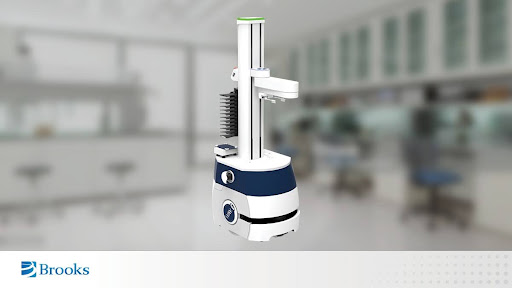
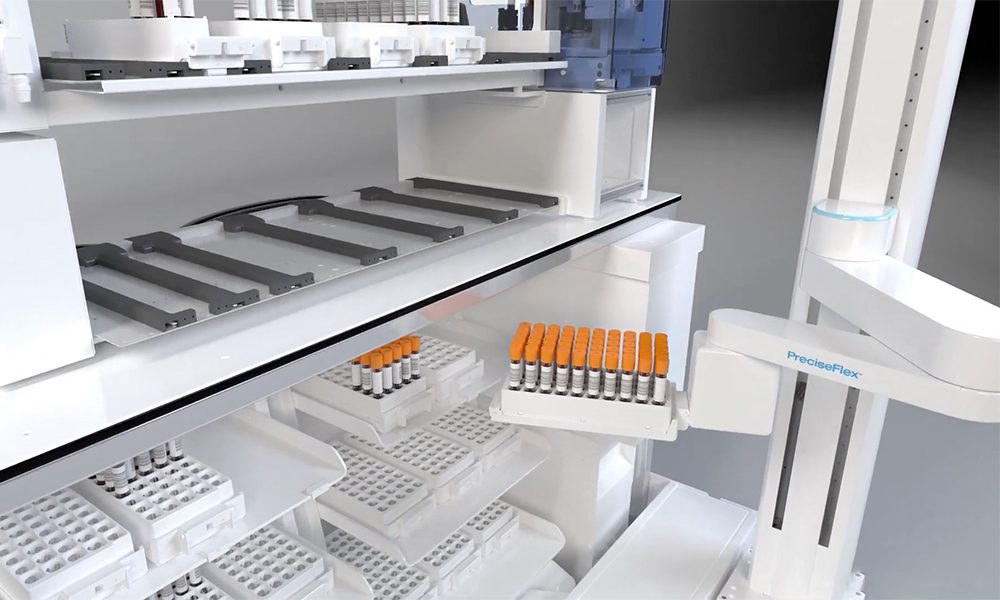
This is where mobile-ready robot architecture matters. PreciseFlex™robots are engineered to support mobile applications. With the energy efficient design, PreciseFlex robots can support 30% longer AMR runtime. Their embedded controls reduce external hardware and support stable, low-power integration.
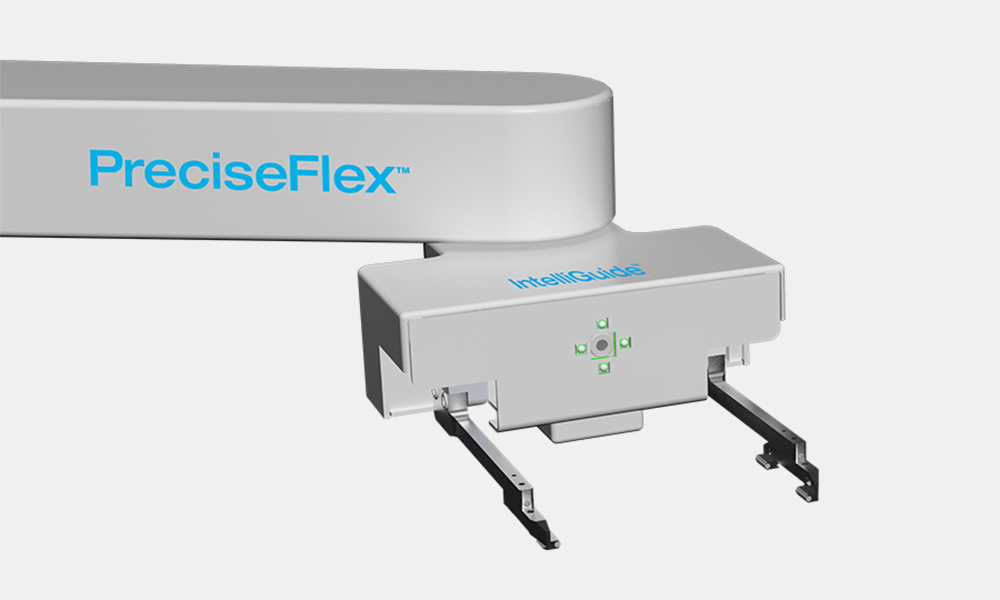
IntelliGuide™ Vision helps close the gap between AMR navigation and precise labware handling by enabling micro-localization in the range of ±1. mm. Its factory-calibrated cameras can also reduce complexity and deployment effort at pick/place locations.
Brooks gripper systems add another layer of reliability by supporting precise interaction with labware, samples, and automation stations. Optional linear rails may also help when labs need extended reach in fixed or semi-mobile workflows, but they should support the larger system design rather than become the focus.
Reliable mobile automation requires more than robot movement. Labs need navigation, handling, vision, software communication, and exception management working together.
Build More Flexible Lab Workflows with Mobile Automation
Mobile robots help labs get more value from the instruments and automation systems they already have. By connecting movement, handling, software, status awareness, and final positioning, mobile robots can reduce manual transport. They also help labs make better use of existing systems without a full redesign.
The best results come from planning the full workflow, not only the AMR route. Labs need reliable navigation and precise pick/place handling. They also need clear system communication and a defined response when conditions change.
Get in touch with our automation team to explore how PreciseFlex™ robots, IntelliGuide™ Vision, and Brooks gripper systems can support precision handling and third-party AMR integration in mobile lab workflows.